Posture Is a Result, Not a Pose
Posture is the position your body settles into when the forces running through it are organised a certain way. Pinning your shoulders back changes the picture for a minute and changes the organisation not at all. At Kinetic Blueprint we measure the pattern underneath, train it, and measure again, because the posture that holds is the one you never had to think about.
Key takeaways
- "Stand up straight" is a cue. Posture is a result. You can't hold a result.
- The research links posture and pain in adults, and it also says a photo of how you stand doesn't predict who gets back pain.
- Training changes posture. Ten trials measured it.
- We don't correct posture by hand. We measure how you move, train the pattern, and re-test.
In this article
- Why "stand up straight" stops working by lunchtime
- What the research actually says about posture and pain
- What we measure instead of judging a photo
- How posture changes when you train the pattern
- What to do this week
- Where this piece comes from
Why "stand up straight" stops working by lunchtime
Everyone has tried it. You catch yourself slumped at a desk, you pull your shoulders back, you lift your chest. Twenty minutes later you're slumped again.
That isn't a discipline problem. It's a mechanics problem.
The slump is where your body goes when the tension through it's distributed a certain way. Tight hip flexors, a ribcage that sits behind the pelvis, feet that don't load evenly. Your head ends up forward because that's where the rest of the structure put it. Pulling it back fights the structure with willpower, and the structure has more patience than you do.
Functional Patterns puts it plainly in their piece on posture: pinning your shoulders back isn't posture, it's compensation. We agree. A pose is something you perform. Posture is something your body arrives at.
What the research actually says about posture and pain
Two things are true at once, and most posture advice only tells you one of them.
The first: posture and pain are linked in adults. A review of ten studies (PMID 31773477) found that adults with neck pain carry their heads further forward than adults without neck pain, and that the further forward the head sits, the higher the pain and disability scores run. Interestingly, the same review found the pattern doesn't hold in teenagers, which tells you age and time under the pattern matter.
The second: a snapshot of how you stand doesn't predict who gets back pain next. An umbrella review that pulled together 41 systematic reviews (PMID 31451200) found both positive and null associations between spine postures, prolonged sitting, standing, bending and low back pain, and limited evidence that any of those things comes before a first episode.
So "is my posture bad?" is the wrong question. A bad photo and a pain-free back coexist all the time. The better question is the one Functional Patterns asks: can your body adapt? Can it absorb impact, rotate, carry load and come back to neutral on its own? That's a question about movement, and you answer it by watching movement.
What we measure instead of judging a photo
A posture photo is a single frame. We take the frame, and then we take the film.
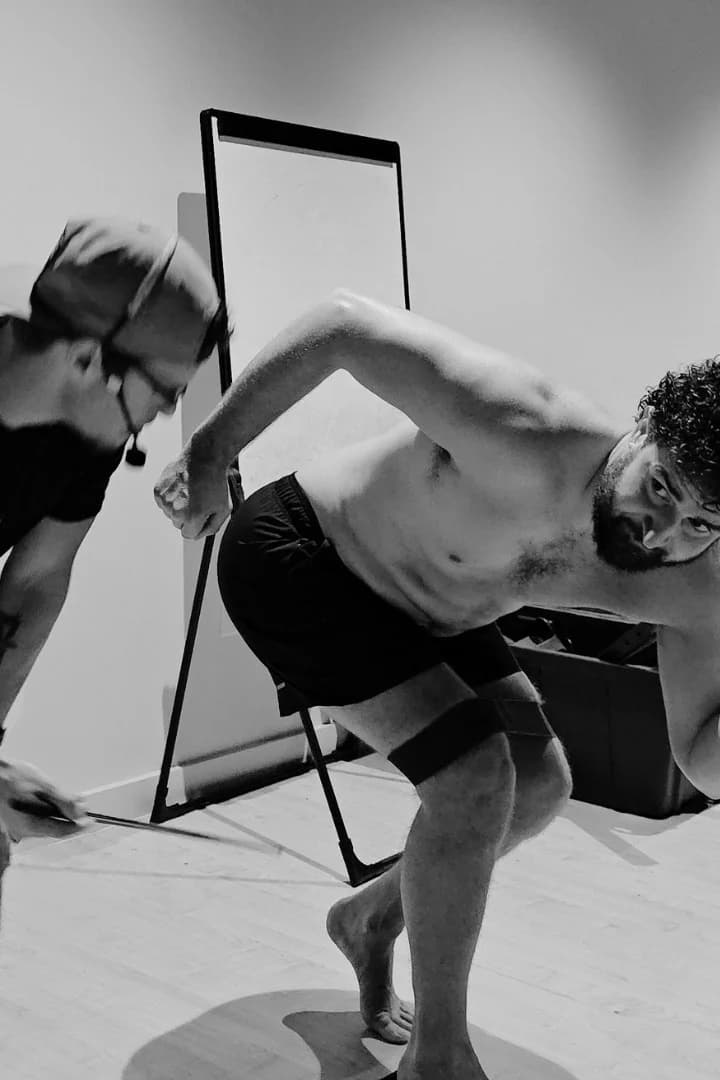
Every client at Kinetic Blueprint starts with an assessment. For posture, that means AI-powered posture analysis from the front, side and in rotation, at rest and under simple movements. Then gait video, because walking is the most repeated movement in a human life and it shows what your posture does when it has a job to do. Then structural alignment, breath pattern and history.
Those measurements tell us where the tension is pooling and where it's missing. The forward head is usually the last link in that chain, not the first. Training the neck alone is like repainting the one wall that keeps cracking.
How posture changes when you train the pattern
Here is the part the "sit up straight" advice leaves out. Posture does change in adults, and it changes through training.
A 2026 review pooled ten randomised trials, 550 people, all with forward head posture (PMID 42445930). The people who trained improved their craniovertebral angle by 3.38 degrees against controls, and their pain intensity and neck function improved with it. Nobody in those trials was told to hold a position all day. They trained.
Our training is organised around the four patterns a human body runs on: stand, walk, run, throw. When the hips learn to extend, the ribcage learns to sit over the pelvis, and the feet learn to load evenly, the head has somewhere to go. It comes back on its own. Then we re-measure, because a result you can't see on a re-test is a story, not a result.
That's the difference between posture correction as we run it and posture correction as a list of cues. Cues ask you to do the work. Training changes what your body does when you're not working.
What to do this week
Stop pulling your shoulders back. It isn't helping, and it's teaching you that posture is something you perform.
Get a baseline instead. The Complimentary Consultation is $0 and includes a movement analysis, so you leave knowing what the pattern is before you decide what to do about it. If you want the full read, the Foundational Assessment at $279 adds AI posture analysis, gait video and an InBody scan, with a plan built from your numbers.
Where this piece comes from
This article builds on Functional Patterns' piece "Posture Matters. But not for the reasons you've been told". Functional Patterns is the biomechanics system every practitioner at Kinetic Blueprint is certified in, and the framework for how we assess and train posture. The argument is theirs. The measurement, the Austin studio and the research references are ours.
Kinetic Blueprint does not diagnose, treat, or cure any condition. If you have pain that is new, severe, or getting worse, see a licensed medical provider.
What the research says about posture and pain
An umbrella review of 41 systematic reviews found both positive and null associations between spinal postures, sitting, standing, bending and low back pain, and limited evidence that any of them comes before a first episode of back pain.
Across ten cross-sectional studies, adults with neck pain carried more forward head posture than adults without it, and in adults the further forward the head sat, the higher the pain and disability scores. The same pattern didn't hold in adolescents.
Across ten randomised trials with 550 participants, therapeutic exercise improved the craniovertebral angle by 3.38 degrees, reduced pain intensity, and improved neck function in people with forward head posture, compared with control groups.
Frequently asked questions
Can posture be changed as an adult?
Does bad posture cause back pain?
What does a posture analysis cost at Kinetic Blueprint?
Will I need to think about my posture all day?
Get measured first
Meet with a movement specialist, discuss your goals and concerns, tour the studio, and learn how our assessment and training process can help you move better.