Recovery Isn't Rest: What Recovery Is For
Recovery isn't the absence of training. It's the part of training where the adaptation happens, and its job is to get you back on the floor on a pattern that holds. Rest is doing nothing. Recovery is a skill with a cadence, and the cadence comes from a measurement, not a mood.
Key takeaways
- Recovery is a skill. Functional Patterns says it, the research on adherence backs it, and we program it.
- The measure of recovery is whether you train again, and whether the re-test holds.
- The evidence on specific modalities is mixed. We say so, and we use them anyway, for a specific reason.
- Your cadence comes from your heart-rate variability and your training load, not from the schedule.
In this article
- Recovery is a skill, not a pause
- The number that tells you recovery is working
- How we set your cadence
- The four modalities, and what we'll and won't claim about them
- What Functional Patterns adds, and what we add
- Who this is for
- Where this piece comes from
Recovery is a skill, not a pause
Functional Patterns opens their recovery piece with an observation that lands if you've ever trained through pain: many of the people with chronic pain are the most active, and some of that activity is reinforcing the pattern that hurts. Their point is that recovery is a learned skill. It means stopping the constant stimulation, from screens and substances as much as from training, and getting the nervous system out of a sympathetic state long enough for tissue to repair and for the body to notice what's actually going on.
We'd say the same thing from the training side. Adaptation happens between sessions. If you never leave the stimulus, you never adapt to it, you just accumulate it. Recovery is where the work from Tuesday becomes a changed pattern by Thursday.
The number that tells you recovery is working
Here's the honest measure, and it isn't how you feel after a session. It's two things.
The first is whether you keep training. An umbrella review of 55 reviews (PMID 33669679) found that among the fourteen factors most often linked to people sticking with an exercise programme are enjoyment with an absence of unpleasant experiences, available progress information and monitoring, and supervision. Recovery that leaves you wanting to come back is doing its job. Recovery as a chore isn't.
The second is whether the re-test holds. Every client here is measured, trained and measured again. If the gait video and the posture read keep moving in the right direction, the recovery cadence is right. If they stall, the first thing we look at is whether you're adapting between sessions or just adding to the load.
How we set your cadence
We don't guess. The Kinetic Blueprint Assessment includes a heart-rate-variability reading, VO2 max and grip strength on top of posture, gait and InBody. HRV is one signal about how your nervous system is handling the load. Your training block is the other. The practitioner uses both to recommend a rhythm that compounds your training instead of competing with it.
VO2 max is in that assessment for a reason that goes past recovery. The American Heart Association's scientific statement (PMID 27881567) holds that low cardiorespiratory fitness is associated with a high risk of cardiovascular disease and all-cause mortality, and recommends measuring it as a clinical vital sign. We measure it because it's a number worth knowing, and because the cadence of hard sessions and recovery sessions is what moves it.
The four modalities, and what we'll and won't claim about them
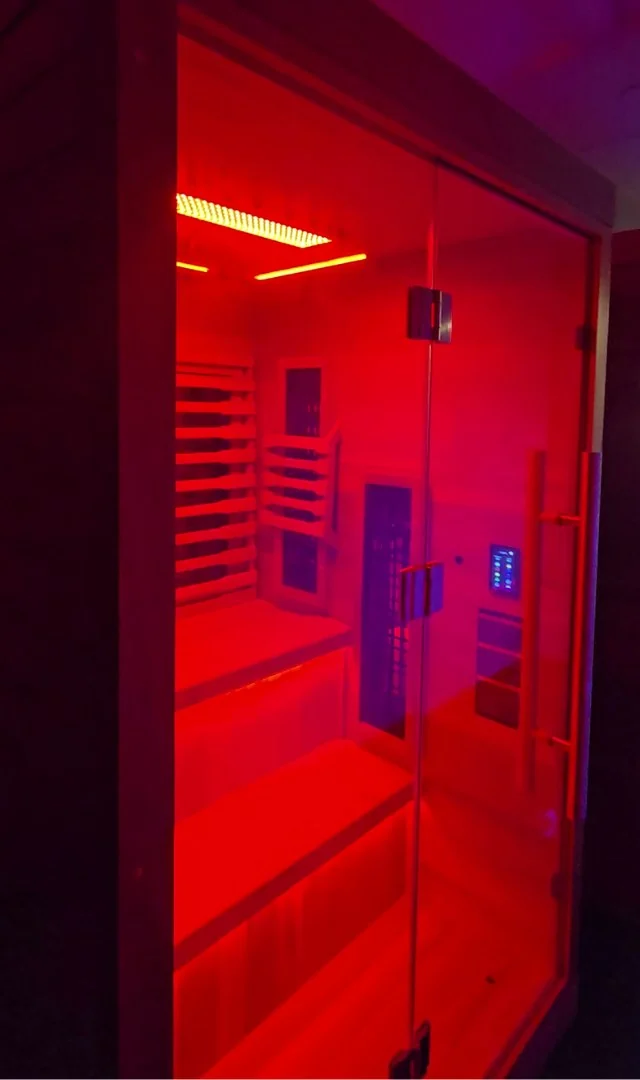
Our recovery studio runs four modalities: infrared sauna, PEMF, Rapid Reboot lymphatic compression and HaloRed O2. Each targets a different layer. You use one, stack two, or rotate the set, depending on what your assessment shows and what block you're in.
We don't lead with clinical claims about any of them. The literature on recovery modalities is mixed and depends heavily on protocol, and we'd rather tell you that than sell you a mechanism.
What we'll tell you is where the evidence is strongest and what it actually covers. The best-known sauna finding is a Finnish cohort of 2,315 men aged 42 to 60, followed for a median of 20.7 years (PMID 25705824). More frequent sauna bathing was associated with lower rates of sudden cardiac death, fatal coronary heart disease, fatal cardiovascular disease and all-cause mortality. Two caveats, both of them load-bearing: it's observational, so it shows association rather than cause, and it studied traditional Finnish sauna, not infrared. Anyone who tells you an infrared sauna has been proven to do what that study measured is reading past the abstract.
So why run the modalities at all? Because the number we track is the one above. Clients who recover consistently train more consistently, miss fewer sessions and hold their re-tests. That's a measurable effect of a recovery rhythm, whatever the mechanism inside the sauna turns out to be.
What Functional Patterns adds, and what we add
Functional Patterns' recovery piece is mostly about behaviour: stillness without a screen, sun, food you cooked, fewer stimulants. We agree with all of it, and we'd add that those are hard to measure, which is why they get skipped.
What we add is the measurement. HRV at assessment. Gait and posture at re-test. A cadence that changes when the numbers do. Recovery as a skill is their frame. Recovery as a number is ours.
Who this is for
If you train hard, feel beaten up, and have been told to either push through or take a week off, this is for you. Neither is a plan. A cadence built from your numbers is.
The Complimentary Consultation is $0 and includes a movement analysis. The Kinetic Blueprint Assessment at $499 is the tier that reads HRV, VO2 max and grip strength, and it's the one that sets a recovery rhythm from your own data. Recovery room sessions come with the Blue and Black memberships; for a single session, ask the studio.
Where this piece comes from
This article builds on Functional Patterns' piece "Why Recovery Matters from a Functional Patterns Perspective". Functional Patterns is the biomechanics system every practitioner at Kinetic Blueprint is certified in. The recovery-as-a-skill frame is theirs. The measurements, the modality caveats, the research references and the Austin studio are ours.
Kinetic Blueprint does not diagnose, treat, or cure any condition. Recovery sessions support training. They are not medical treatment.
What the research says, and where it stops
In 2,315 Finnish men aged 42 to 60 followed for a median of 20.7 years, more frequent sauna bathing was associated with lower rates of sudden cardiac death, fatal coronary heart disease, fatal cardiovascular disease and all-cause mortality. This is an observational cohort of traditional Finnish sauna, not a trial and not infrared.
The American Heart Association's scientific statement holds that low cardiorespiratory fitness is associated with high risk of cardiovascular disease and all-cause mortality, and recommends assessing it as a clinical vital sign.
American Heart Association: cardiorespiratory fitness as a clinical vital sign, vs scientific statement, not applicable, general population (PMID 27881567)
Across 55 reviews, enjoyment with an absence of unpleasant experiences, available progress information and monitoring, and supervision were among fourteen factors most often linked to people sticking with an exercise programme.
Frequently asked questions
Does infrared sauna help recovery?
How often should I do recovery sessions?
Can I book recovery without a membership?
What does an assessment cost?
Set your cadence from your numbers
Meet with a movement specialist, discuss your goals and concerns, tour the studio, and learn how our assessment and training process can help you move better.