
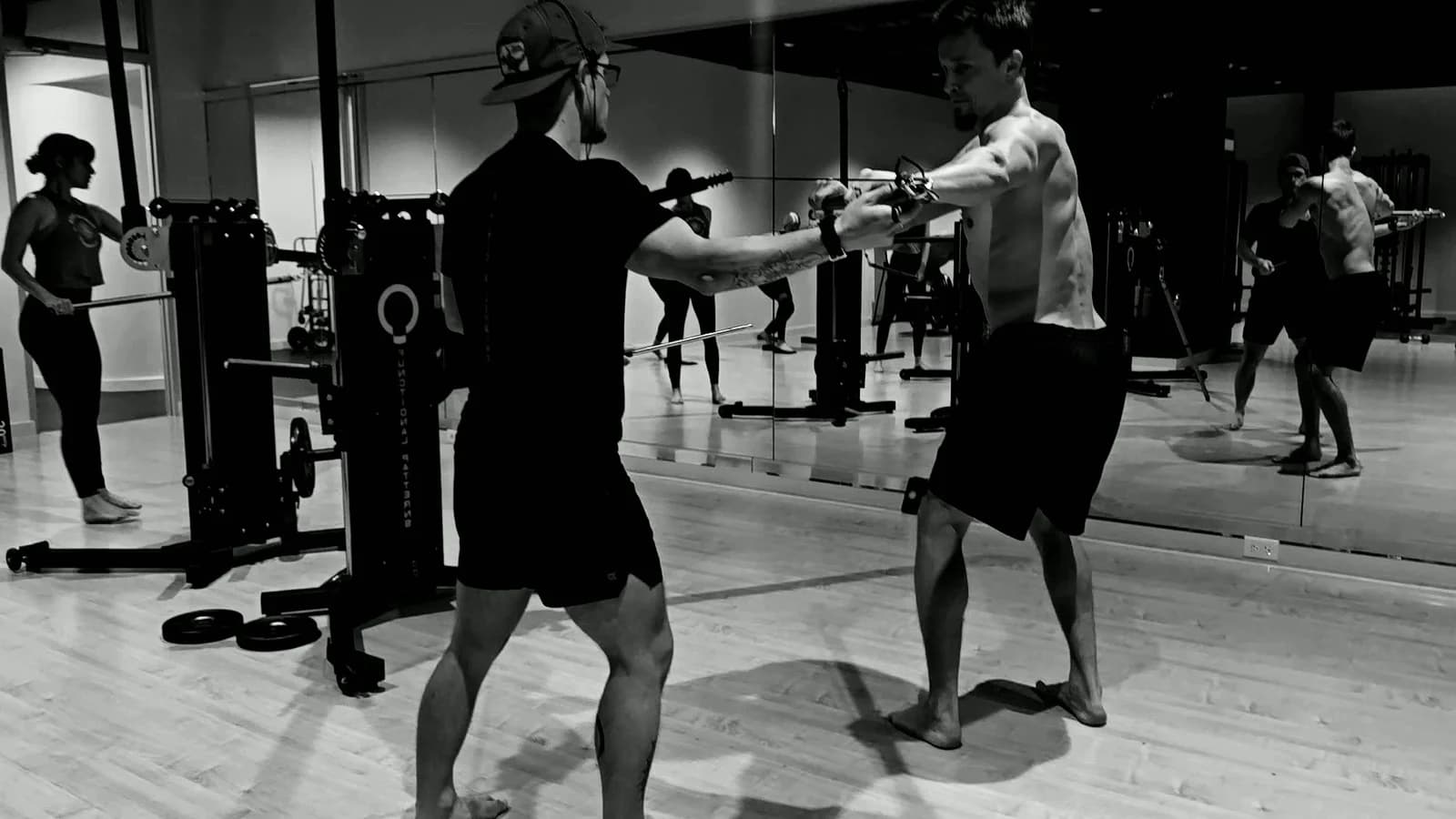
Shoulder Pain: Why Rotator Cuff Rehab Stalls When the Chain Isn't Trained
Rotator cuff rehab stalls because it treats the shoulder as a joint when the shoulder is the end of a chain. Force for every reach, press and throw starts at the feet and travels up through the hips and trunk. If a link below the shoulder is weak or out of sequence, the cuff takes the load it was never built for, and strengthening the cuff alone just builds a stronger link in a broken chain.
Key takeaways
- Exercise is the first-line answer for shoulder pain. The research is unusually clear on that.
- Specific exercise beats generic exercise. Which exercise matters more than whether you exercise.
- The shoulder is the end of a whip that starts at the ground. Rehab that never looks below the ribs misses the cause.
- We measure the chain, train it, and re-test the shoulder.
In this article
- The standard rehab script, and where it ends
- What the research actually says
- Why the chain matters more at the shoulder than anywhere else
- How we train it at Kinetic Blueprint
- Who this is for
- Where this piece comes from
The standard rehab script, and where it ends
If you've had shoulder pain, you know the script. Pendulums. Banded internal and external rotation. Rows and retractions. Four to six weeks, then "keep doing these forever."
The exercises aren't wrong. The frame is. Every one of them treats the shoulder as a thing that lives on its own, hanging off the side of a body that isn't involved.
Functional Patterns makes this point in their piece on rotator cuff physical therapy: the shortcoming isn't the exercises, it's the lack of integration. The shoulder works as part of the whole body, so a problem that shows up at the shoulder often starts somewhere else. Ribcage position. How the trunk rotates. How the hips load.
We'd add one thing. The research agrees with them, and has for over a decade.
What the research actually says
Three findings, in order of how much they change the plan.
First, exercise wins. A 2017 review in the British Journal of Sports Medicine (PMID 28630217) pooled trials on conservative care for shoulder impingement. Exercise beat non-exercise treatments for pain by a large margin. Injections helped against nothing, anti-inflammatories helped a little against placebo. A 2020 update of the systematic reviews (PMID 31726927) went further and made a strong recommendation for exercise therapy as the first-line treatment for subacromial shoulder pain, with moderate evidence of no effect for laser, shockwave, pulsed electromagnetic energy and ultrasound.
So the question was never "exercise or something else." It was always which exercise.
Second, specific beats generic. The same 2017 review found that specific exercises outperformed generic ones. That line is the one most rehab plans skip. A sheet of band drills is generic by definition. It was printed before anyone measured you.
Third, the chain is real. A 2012 framework paper (PMID 22666599) laid out what sports medicine calls the kinetic chain: force in an upper-limb task develops from the ground up, proximal to distal, and a deficit in the legs or trunk shows up at the shoulder. Its conclusion is the one we'd put on the wall: shoulder rehabilitation should evaluate and restore every kinetic chain deficit, lower body included.
Put those three together and you get a plan that looks nothing like pendulums.
Why the chain matters more at the shoulder than anywhere else
The shoulder is the most mobile joint in the body, which is another way of saying it's the least stable. It stays stable by being the end of a sequence, not by being strong on its own.
Watch a throw. The back foot drives, the hips turn, the trunk rotates, the ribcage opens, and the arm comes through last, carrying energy the legs made. The rotator cuff's job in that sequence is to decelerate the arm and keep the ball of the humerus in its socket. A small job, timed well.
Now take the hips and trunk out of the sequence. Sit at a desk for ten years so the ribcage drops and the hips stop rotating. The arm still has to reach, press and throw, so the cuff starts making force instead of steering it. That's the load it was never built for. Strengthen the cuff in isolation and you've asked it to do the wrong job, harder.
That's why we treat shoulder pain as a whole-chain problem and why our performance work for swinging and throwing starts at the feet.
How we train it at Kinetic Blueprint
Every client starts with an assessment, and for shoulder pain the shoulder is the last thing we look at.
Gait video shows us whether the hips extend and rotate when you walk, because if they don't rotate walking, they won't rotate throwing. Posture analysis shows us where the ribcage sits relative to the pelvis. Breath pattern tells us whether the ribcage can move at all. Then we look at the shoulder, and usually the shoulder makes sense.
Training follows the chain. Hips first, trunk rotation second, the ribcage and shoulder blade third, the arm last. The pattern we build toward is the throw, because the throw is the movement the shoulder evolved for. Then we re-test the shoulder. If it hasn't changed, the plan does.
That's the specific in "specific exercise." Not a different band colour. A programme built from a measurement of your chain.
Who this is for
If you're searching for a trainer who understands shoulder pain, and you've already done the band drills, this is for you. Bring the sheet. We'll show you what it was missing.
The Complimentary Consultation is $0 and includes a movement analysis. The Foundational Assessment at $279 adds gait video, AI posture analysis and an InBody scan, with a plan built from your numbers.
Where this piece comes from
This article builds on two Functional Patterns pieces: "Physical Therapy for Rotator Cuff: Is It Effective or Is There a Better Alternative?" and "Understanding Rotator Cuff Injuries: Causes, Rehabilitation, and Prevention". Functional Patterns is the biomechanics system every practitioner at Kinetic Blueprint is certified in. The integration argument is theirs. The research references, the measurements and the Austin studio are ours.
Kinetic Blueprint does not diagnose, treat, or cure any condition. A shoulder that gave way, that you can't lift, or that hurts at night after an injury needs a licensed medical provider before it needs a trainer.
What the research says about shoulder pain and exercise
In adults with shoulder impingement, exercise beat non-exercise treatments for pain, and specific exercises beat generic ones. Adding manual therapy to exercise helped only at the shortest follow-up.
An update of systematic reviews makes a strong recommendation for exercise therapy as the first-line treatment for subacromial shoulder pain, and finds moderate evidence of no effect for laser, shockwave, pulsed electromagnetic energy and ultrasound.
The kinetic chain framework holds that force in an upper-limb task builds from the ground up, proximal to distal, so a deficit in the legs or trunk shows up at the shoulder, and shoulder rehabilitation should evaluate and restore every link in that chain.
Sciascia 2012: kinetic chain rehabilitation, a theoretical framework, a theoretical framework, not a trial (PMID 22666599)
Frequently asked questions
Is physical therapy or training better for rotator cuff pain?
Should I stop lifting if my shoulder hurts?
Do you treat rotator cuff tears?
What does it cost to get my shoulder assessed?
Train the whole chain
Meet with a movement specialist, discuss your goals and concerns, tour the studio, and learn how our assessment and training process can help you move better.